August 31, 2025
By John Ferrandino

Characters: Daniel Plainview, Eli Sunday, H.W. Plainview
Plot: Daniel Plainview is an oil prospector in the early 20th century. He adopts the son of a dead miner, H.W. Plainview. He creates the image of a loving father in order to to get favorable land deals. A man from California named Paul Sunday approaches him and tells him of an oil deposit under his home ranch. Over the next 10 years, Daniel becomes an oil tycoon, shedding the factors of his humanity; his son becomes deaf due to a gas vent rush at the oil rig, Henry, a man who claims to be Daniel’s brother, and the local preacher and Paul’s brother, Eli Sunday, whom Daniel develops a rivalry with.
Inspirations: This film is based on “Oil”, by Upton Sinclair, an activist and writer during the Gilded Age who wrote about unsafe working conditions in “The Jungle”, in order to raise awareness. He was a muckraker, a writer who worked to expose corruption in US industries. Other works include “The Brass Check”. criticizing yellow journalism. “King Coal” and “The Flivver King” exposed the coal and automotive industries’ unsafe working conditions. “Oil” deals with the oil industry and focuses on the conflict between a son and his oil tycoon father. The film’s director, Paul Thomas Anderson, adapts the first 150 pages and puts it in the father’s perspective. He changed the title because his screenplay was so different from the novel.
“I drink your milkshake.”, the most famous quote of the film, is based on Albert Fall’s Teapot Dome Scandal speech and by Sen. Pete Domenici’s speech on drilling in the Arctic National Wildlife Refuge.
Motifs: Family man, oil, Third Revelation, drinking, and the American Dream
Anderson’s protagionist is the deplorable Daniel Plainview, but the audience can follow him because he tries to be the American Dream ideal entrepreneur and a father. He is ambitious, manipulative, cynical, and amoral. He adopts H.W. in order to come off as a trustworthy man and claims to know his men personally. His greed and self centeredness reveals itself when the oil rig first reaches oil, H.W. becomes deaf. The rig catches fire and he just watches as it burns through the night into the next noon.
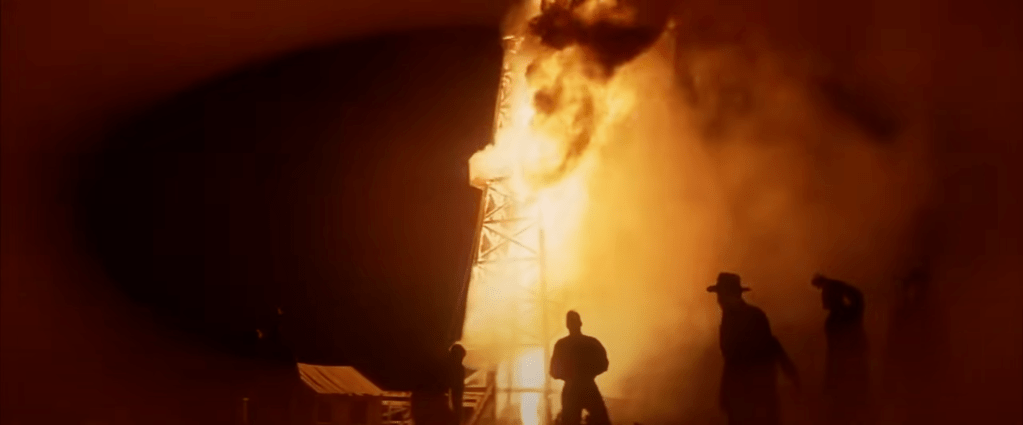
The sight of the burning oil rig is a tunnel vision, blurred around the edges, clear in the center. This is Plainview’s perspective, the profit that is his. The music is just a beating, screeching, mechanical sound, a blend of the oil rig’s machinery and Daniel’s heartbeat the only thing that he senses. He doesn’t care about the men who died to build it and he doesn’t check to see if his son is okay, who is showing signs of deafness.
“There is a whole ocean under our feet and it’s all mine.”
Plainview’s relationship with Eli Sunday is of one conman to another. Anderson has the same actor portray Paul and Eli, hinting at similar motives of the brothers. Paul tells Daniel about the oil, and Eli negotiates a church to be built on the land around the rig with him as the preacher of the Third Revelation Church. Named after the time God will message his prophets in the Book of Revelation. This is ironic because Eli does not use a Bible for his sermons. He makes a show out of it and puts social pressure on Daniel to confess his sins and admit he abandoned his son. Eli’s influence and power grows with Daniel’s wealth. He becomes a radio televangelist in the 20s.
A man named Henry arrives and claims to be Daniel’s brother, but is revealed to be a fraud who assumes the name and diary of the real Henry after he dies, in order to get to Daniel’s wealth. Daniel kills him and buries him. This is discovered and is the catalyst for his public repentance in the Third Revelation.

Oil represents wealth and human greed. Daniel is covered in it, H.W. is deaf because of it, and Henry is buried as his grave pools with oil in the ground.
Conflicts:
Daniel’s pursuit of wealth
Daniel’s loss of humanity
H.W.’s abandonment
Eli’s religious ferver
Rivalry between Daniel and Eli
Henry’s deception
Meaning of title ‘There Will Be Blood’, the willingness of ambitious men, like Daniel and Eli, to use and discard anyone in order to achieve wealth. Reflects real historical figures in the early 20th century and late 19th century; industrialists, politicians, and preachers that are akin to Daniel and Eli.
“I hate most people. There are times when I look at people and I see nothing worth liking. I want to earn enough money so I can get away from everyone.”
“Ive abandoned my child! I’ve abandoned my boy!”
“You’re lower than a bastard. You have none of me in you. You’re just a bastard from a basket.”
“I DRINK YOUR MILKSHAKE. SCCHCHHSHSCHSHCHSLLLSSHHHH. I DRINK IT UP!”

In the final confrontation between Daniel and Eli, H.W. is grown up, married, and starting his own business. When Daniel reveals H.W.’s true status, its to his immense relief that he has none of Daniel in him. It’s the eve of Black Tuesday and Eli is offering to sell the last land on his ranch not owned by Daniel. Daniel makes Eli renounce his god, then reveals that he siphoned out the oil years before, so that land is useless. He berates Eli, calls him the “afterbirth” after his twin brother. He compares his theft of his oil like a long straw reaching across the room drinking his milkshake. He mocks his religion by calling his sermons tribal dances, dancing while doing so, and he declares himself to be the true third revelation, he will eat Eli, he ends his life by bludgeoning him with a bowling pin.
“I’m finished”, are Daniel’s final words, as he is done pretending to be humane.
Themes: Greed, American Dream’s dark side, ambitions affects on oneself and others, disabilities, abandonment, cruelty, and hatred
 IBanalysis
Leave a comment