By John Ferrandino
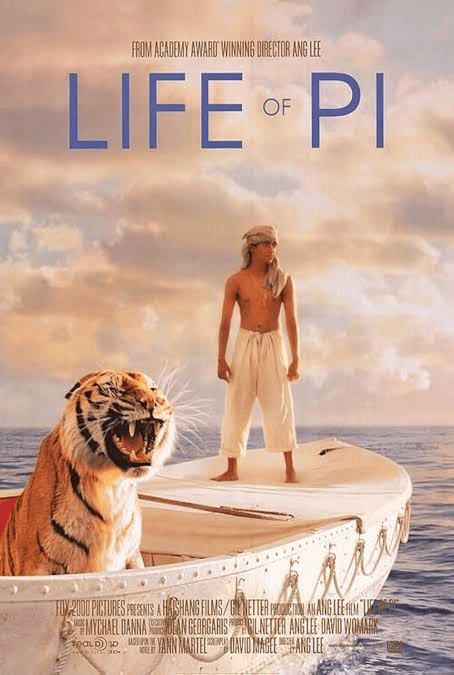
Characters: Piscine Molitor “Pi” Patel, Richard Parker, and the writer
Plot: A Indian Canadian tells his life story to a novelist. He was named after a French swimming pool, but changed his name to the Greek letter pi after his classmates kept calling him ‘pissing’. His father was a zookeeper, so when his family moved to Canada, they took their animals with them. A storm two days out of Manilla sinks the ship and Pi is the only human survivor. He shares a lifeboat with an adult bengal tiger named Richard Parker. After more than 200 days adrift in the Pacific Ocean, they both land in Mexico.
Inspirations: Maritime disasters, hinduism, five stages of grief, zoology, and metaphysics
The author, Yann Martell, wanted to write about himself finding the meaning of reality. Pi is his self insert. When researching maritime disasters, the name Richard Parker would appear as a survivor of the wreck, but still have to survive the ocean. Martell found that name to be an omen or karma, so that is what he named the tiger.
Pi is a letter in the Greek alphabet and the number used to find the circumference of a circle using the radius. It starts with 3.14 then goes on forever.

Pi’s zoological knowledge comes from his father, which he uses to train Richard Parker, using rewards and punishments and associating them with whistle calls. This is behaviorism was researched and experimented by psychologist B.F. Skinner, famous for training pigeons to play pingpong.
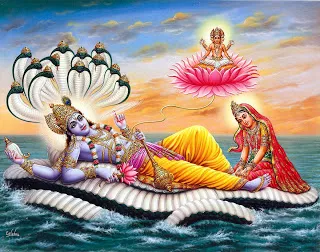
Motifs: π, Vishnu, hinduism, zoology, tiger, orangutan, zebra, hyena, religions, meat, ocean, lifeboat, storms, aspect ratios, and bioluminescence
Pi chooses to follow multiple religions in order to feel fulfilled in his questions about the universe. Hinduism is the religion of his mother and the gods and goddesses were his superheroes growing up. Christianity fascinated him in its love and sacrifice and hits god’s son wanting to be human. Islam provided Pi with order and physical beauty that inspired him.
He chose π as his name because it is simple and complex at the same time, shaped like a house, but an endless numerical value.
Pi understands the diversity of life from his father, a zookeeper.
When he starts his journey, he shares the lifeboat with a zebra with a broken leg, a mother orangutan, a aggressive hyena, and a bengal tiger. When asked to tell simpler story, he replaces the animals with a sailor with a broken leg, his mother, a crass cook, and himself. Just like Richard Parker kills the hyena, Pi kills the cook.
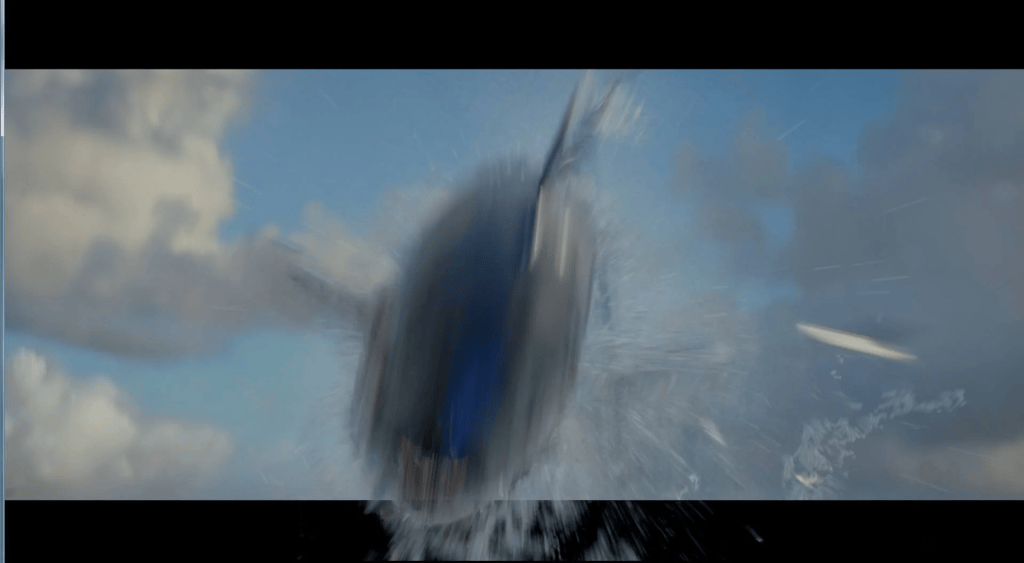
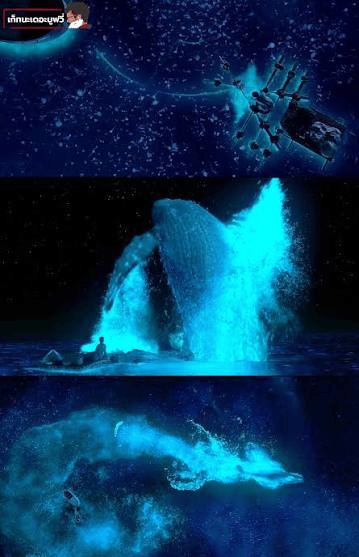
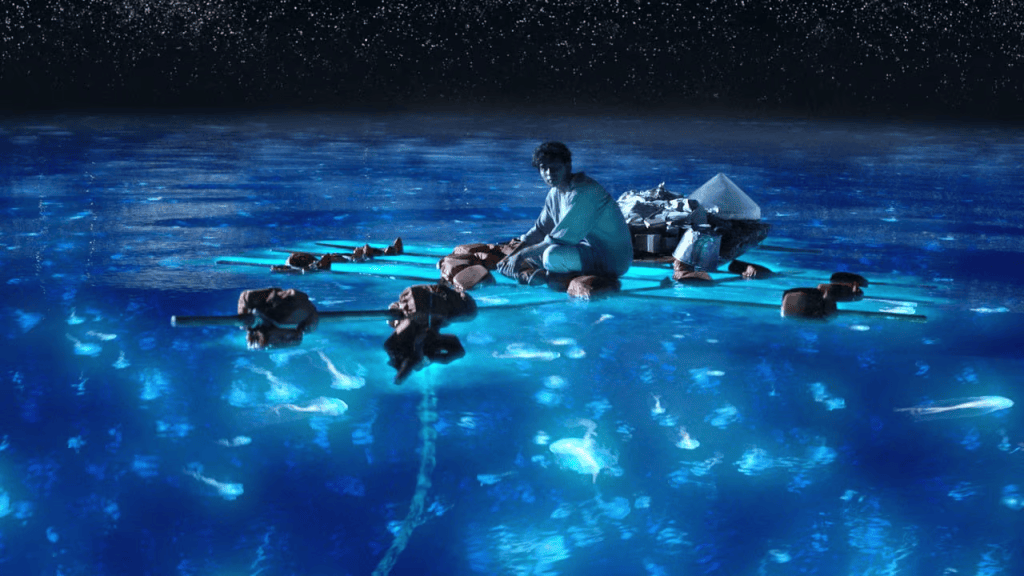
Most of the story is hard to believe, so the film’s director, Ang Lee, made sight and touch an important sensation for Pi and therefore the audience to experience. Most of the film is in the regular theatrical aspect ratio, but for the flying fish scene, the ratio changes to widescreen, black strips on the top and bottom. When the fish swim, they break frame, giving the audience the feeling of spatial depth and movement. For the whale and bioluminescence scene, the frame becomes boxier, black bars on the sides, in order to focus on literal up and down depth for the whale coming up and breaking the surface. It looks just like the book cover. The water also lights up when Pi touches it.
When Pi and Richard Parker land on an island, it provides all the nutrition and rest they need. Then the pools turn to acid and Pi discovers a human tooth in a flower. It is a carnivorous island. A wide shot reveals the island is shaped like a human. In hinduism, Vishnu the creator sleeps on the cosmic ocean, and reality is the stuff of his dreams. Destruction occurs when he wakes up. The ocean fish killed by the acid pools are absorbed by the island and consumed by direct contact with the roots, as shown with the fish bones tangled in the island’s root system. A being that creates life from death is a common motif in east and south Asian mythologies, another example being the Forest Spirit from Princess Mononoke, who must take a life in order to give life.
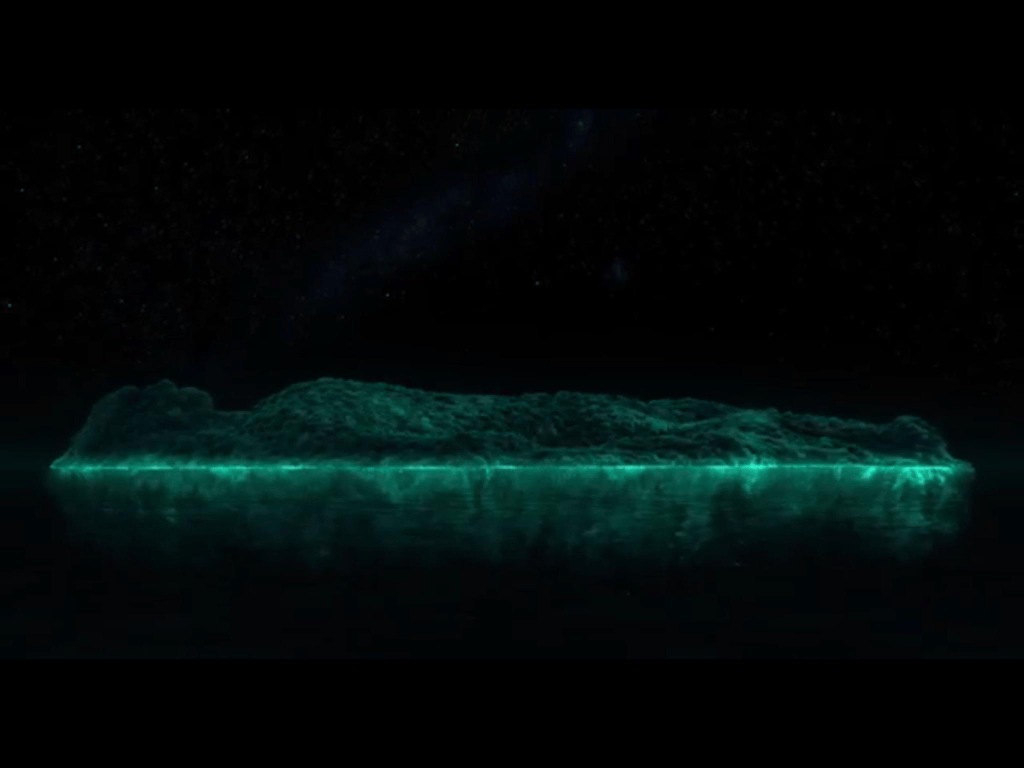
The island also represents Maya, a place of illusion and magic.
Meat is the biggest factor in Pi’s and Richard Parker’s survival. Richard Parker is a carnivore, which keeps Pi alert, keeping him alive, and Pi is a vegan, but succumbs to eating fish and possibly human.
The ocean is like a desert, holding both sides of extreme temperatures. When it doesn’t rain, Pi has no drinking water, no clouds for shade, and the water is as still as sand. When it does rain, it comes with chills, waves, and lightening. Pi compares it to consummation, you can have too much food and be sick or have to little and be sick.
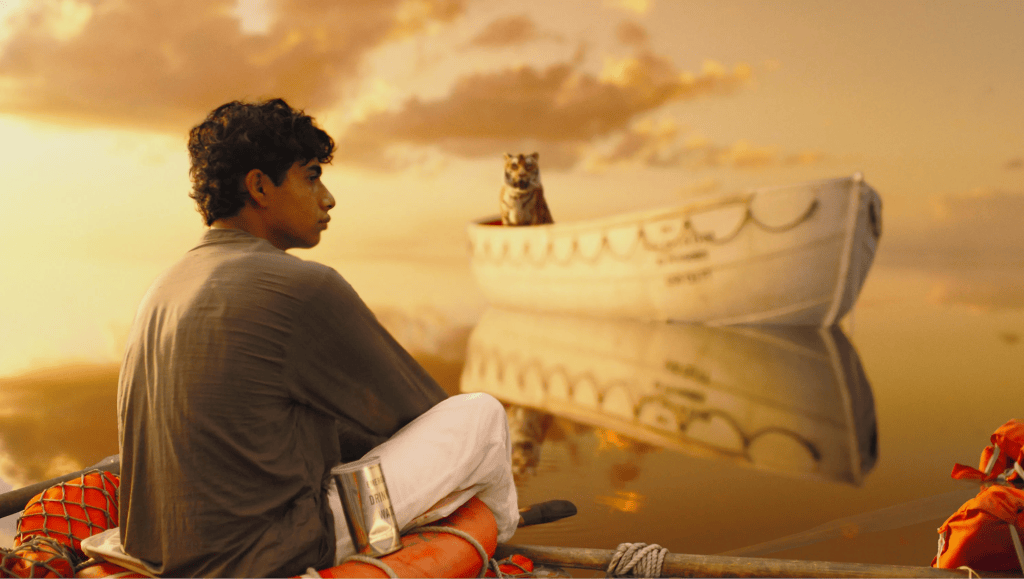
Conflicts: stages of grief, religion, survival, reasons to believe in a higher being, rationality vs irrationality, reality vs memory, fear of the truth, cannibalism, and credibility
After the death of his family on the ship, Pi’s pacific journey, real or imagined, can be divided into stages mirroring the stages of grief; denial, aggression, bargaining, depression, and acceptance.
After the tragedy, he is in denial, superimposing the image of his mother onto the orangutan OJ. The tiger remains hidden. He experiences aggression towards the hyena after it kills the zebra and OJ, that is when Richard Parker emerges and kills the hyena. Pi then moves his anger onto the tiger. The bargaining stage is when Pi trains Richard Parker to not kill him. He makes his own raft tethered to the lifeboat. A storm blows it away and he and the tiger now have to share the same boat, but are okay with each other while being malnourished and depressed. When they get to Vishnu Island, Pi starts to regain his goal of finding civilization, that is him breaking out of the consoling stupor that the Maya provides him, breaking out of his depression. When the two of them beach in Mexico, Richard Parker leaves him without fanfare, it is acceptance.
When insurance agents from the Japanese transportation ministry arrive to find out why the ship sank and Pi tells them his story to their incredulousness. So instead he tells them a more believable story where it was his mother, a sailor, and a cook who survived. The cook chopped of the sailor’s leg for bait to the horror of Pi and his mother. When his mother finds out about Pi’s abuse from the cook and that they have eaten the sailor’s meat, she attacks him and is killed. Pi kills the cook then eats him. Richard Parker is Pi’s wrath and survival instinct. Both the humans and the animals in both stories are based on Pi’s perceptions of his faiths. OJ and his mother represent hinduism, the sailor and zebra are christianity, and the cook and hyena are islam. OJ and his mother are his childhood, the broken leg of the sailor and zebra are physical forms of christianity’s love and sacrifice, and the cook and islam are incompatible with the weaker faith and polytheistic faith. Pi has this struggle in his head while he attempts to survive, then the tiger comes out and rejects all of the dogma.
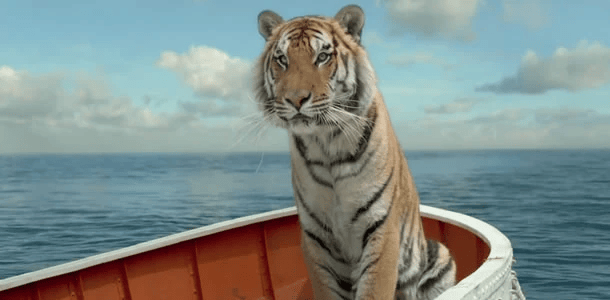
Pi might be Richard Parker. When Pi is blinded and the lifeboat comes across a French castaway, he can only hear him scream as Richard Parker eats him. There is no eyewitness.
Pi can’t provide evidence for either story, so he asks the agents which story they prefer. They choose the animals.
The point of the story is to not determine which story is true, but to show that the rational can be irrational, just like the Greek letter.
“In both stories the ship sinks, my family dies, and I suffer.”
“I wouldn’t be alive without Richard Parker.”
“Thank you. And so it goes with God.” – Pi’s resolution to the Japanese insurance agents and the writer, that the truth what they believe in.
Themes: People choose stories that are more pleasant, power of storytelling, life is accepting loss, the rational can exist with the irrational, belief can exist without proof, and survival is violent


Leave a Reply