• By John Ferrandino

    Characters: Scott Pilgrim, Ramona Flowers, Wallace Wells, Knives Chau, Kim Pine, Young Neil, Stephen Stills, Julie Powers, Envy Adams, Gideon Graves, Lucas Lee, Todd Ingram, Mathew Patel, and Moxxie Richter

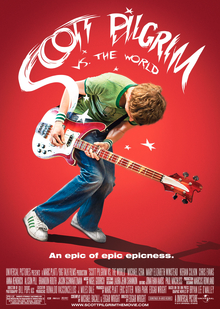
    Plot: (Vs The World) Scott Pilgrim is a normal 22 year old living in Toronto, Canada. He lives with his cool gay roommate, Wallace Wells, is the lead guitarist in the indie band, Sex Bob-Omb, and dates a 17 year old named Knives Chau. Otherwise he is an unemployed slacker. He meets Ramona Flowers, a delivery girl who can roller skate in his dreams by a neural highway. He finds her interesting so he takes her out on a date, but to get to the next base, he must defeat her seven evil exes
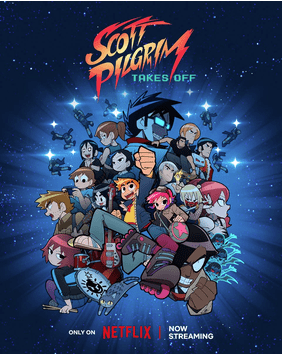
    (Takes Off): A sequel to Vs The World, Scott and Ramona have a bad breakup after their honeymoon. Scott becomes Old Scott and uses a robot using a vegan portal to stop his younger self from getting together with Ramona. During Scott’s fight with Mathew Patel, the robot takes him through a vegan time portal, with everyone assuming that he is dead.

    Inspirations: Bryan Lee O’Malley’s love of indie rock and shonen style manga, Plumtree’s song, “Scott Pilgrim, various characters named after musicians, Nintendo games based styles for the setting, 2000’s indie culture: garage bands, geek culture, and 80’s nostalgia; and love models: Gottman’s Four Horsemen, Knapp’s relationship development model, attachment theory, and Sternberg’s Triangle; and Peter Pan Syndrome.

    Motifs: Health bars, game points, relationships, exes, changing hair colors of Ramona, and veganism

    The world of Scott Pilgrim is unserious. The main character is a slacker and a pedophile, the physics is a mix of Shonen and retro gaming, and Scott doesn’t have a complex view of relationships, treating everyone like acquaintances, even ex girlfriends, like Kim, Knives, and Envy. His current residence with Wallace is only because he dropped by and never left. He’s carefree, but aloof and insensitive.

    The physics of this world are a mix of of Shonen fights and retro gaming logic.
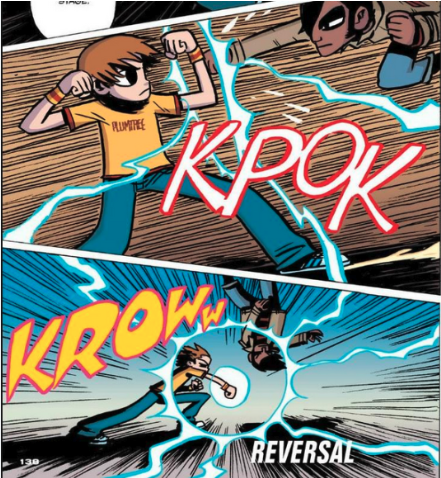
    (Scott Pilgrim vs Mathew Patel)
    (Naruto vs Sasuke, Naruto)
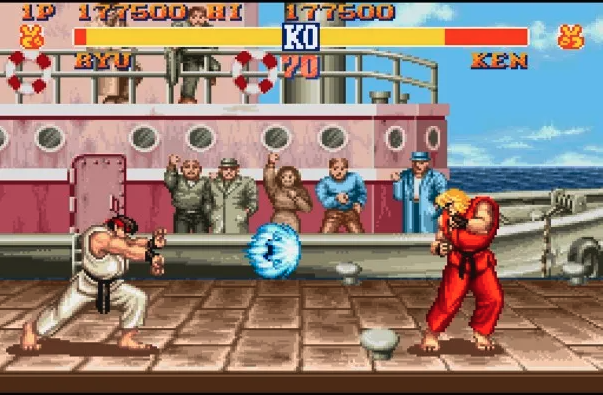
    (Street Fighter)

    Characters have insane powers, like Ramona’s subspace travel, Todd’s vaganism based powers, Mathew Patel’s Indian mystical powers, and Scott’s super-strength. The rest of the characters treat this like its normal, and the only time law enforcement shows up is when Todd Ingram breaks the vegan code. The fights in the graphic novel are Shonen style, like Bleach and Naruto, and the defeated side turns into Canadian coins, like in MarioBros., and K.O. appears overhead. The movie and anime expand on this by adding health bars and a street fighter style narrator and font.
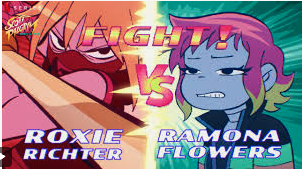
    Ramona has an issue with commitment, and this is illustrated by the existence of the Evil Exes Organization and her constantly changing her hair dyes.

    “I run away from the thing that I love.” “I never want to feel stuck.”

    She doesn’t want too commit herself, because she fears she will be stuck in monotony, so she breaks off her previous relationships. These are the Seven Evil Exes. In the anime, each episode begins with her changing hair dyes in the morning.

    Conflicts: Scott vs himself (Nega-Scott)

    Scott vs his future (Older Scott)

    Ramona’s fear of commitment

    Scott breaking up with Knives

    Scott vs the Evil Exes

    Ramona’s past haunting her

    Running from the past or being obsessed with it, which is the goal of the Evil Exes, to get back with Ramona.

    The world of Scott Pilgrim is the real world, but with the physics of beloved pop culture mixed in, like a distraction. Scott and other characters try to live like its their favorite video game or comic, but no matter how much they try, real world issues like unemployment, toxic relationships, taking advantage of minors, obsession, relationship experimentation, and break ups, are still relevant, and are more highlighted in a fantastical world like Scott Pilgrim. People don’t get killed, they just turn into currency. All of the characters are attempting to live a life of escapism, similar to the readers and watchers of this IP.

    Themes: Escapism, forming of relationships. fear of commitment, adulthood’s consequences, self-respect, self-esteem, Peter Pan syndrome, obsession, aloofness, and hero worship.

  • August 31, 2025

    By John Ferrandino

    Characters: Daniel Plainview, Eli Sunday, H.W. Plainview

    Plot: Daniel Plainview is an oil prospector in the early 20th century. He adopts the son of a dead miner, H.W. Plainview. He creates the image of a loving father in order to to get favorable land deals. A man from California named Paul Sunday approaches him and tells him of an oil deposit under his home ranch. Over the next 10 years, Daniel becomes an oil tycoon, shedding the factors of his humanity; his son becomes deaf due to a gas vent rush at the oil rig, Henry, a man who claims to be Daniel’s brother, and the local preacher and Paul’s brother, Eli Sunday, whom Daniel develops a rivalry with.

    Inspirations: This film is based on “Oil”, by Upton Sinclair, an activist and writer during the Gilded Age who wrote about unsafe working conditions in “The Jungle”, in order to raise awareness. He was a muckraker, a writer who worked to expose corruption in US industries. Other works include “The Brass Check”. criticizing yellow journalism. “King Coal” and “The Flivver King” exposed the coal and automotive industries’ unsafe working conditions. “Oil” deals with the oil industry and focuses on the conflict between a son and his oil tycoon father. The film’s director, Paul Thomas Anderson, adapts the first 150 pages and puts it in the father’s perspective. He changed the title because his screenplay was so different from the novel.

    “I drink your milkshake.”, the most famous quote of the film, is based on Albert Fall’s Teapot Dome Scandal speech and by Sen. Pete Domenici’s speech on drilling in the Arctic National Wildlife Refuge.

    Motifs: Family man, oil, Third Revelation, drinking, and the American Dream

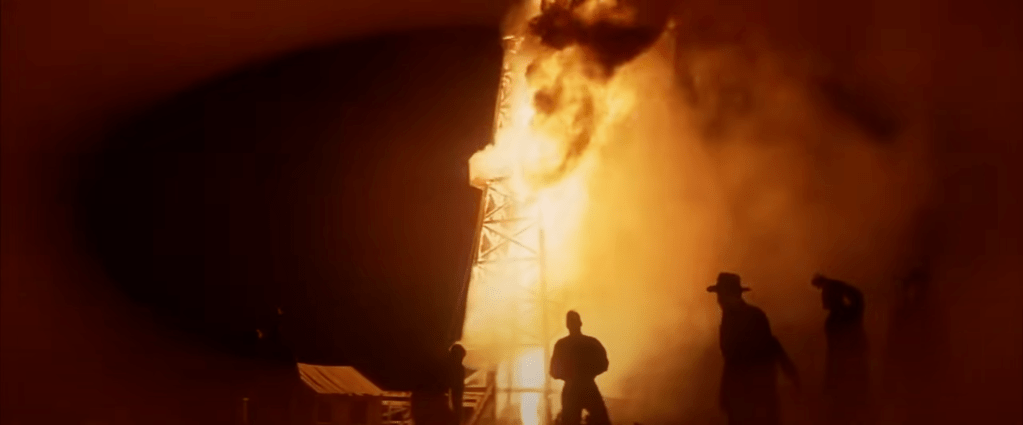
    Anderson’s protagionist is the deplorable Daniel Plainview, but the audience can follow him because he tries to be the American Dream ideal entrepreneur and a father. He is ambitious, manipulative, cynical, and amoral. He adopts H.W. in order to come off as a trustworthy man and claims to know his men personally. His greed and self centeredness reveals itself when the oil rig first reaches oil, H.W. becomes deaf. The rig catches fire and he just watches as it burns through the night into the next noon.

    The sight of the burning oil rig is a tunnel vision, blurred around the edges, clear in the center. This is Plainview’s perspective, the profit that is his. The music is just a beating, screeching, mechanical sound, a blend of the oil rig’s machinery and Daniel’s heartbeat the only thing that he senses. He doesn’t care about the men who died to build it and he doesn’t check to see if his son is okay, who is showing signs of deafness.

    “There is a whole ocean under our feet and it’s all mine.”

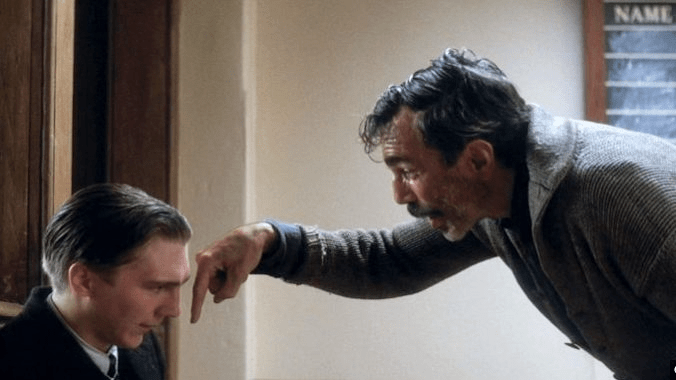
    Plainview’s relationship with Eli Sunday is of one conman to another. Anderson has the same actor portray Paul and Eli, hinting at similar motives of the brothers. Paul tells Daniel about the oil, and Eli negotiates a church to be built on the land around the rig with him as the preacher of the Third Revelation Church. Named after the time God will message his prophets in the Book of Revelation. This is ironic because Eli does not use a Bible for his sermons. He makes a show out of it and puts social pressure on Daniel to confess his sins and admit he abandoned his son. Eli’s influence and power grows with Daniel’s wealth. He becomes a radio televangelist in the 20s.

    A man named Henry arrives and claims to be Daniel’s brother, but is revealed to be a fraud who assumes the name and diary of the real Henry after he dies, in order to get to Daniel’s wealth. Daniel kills him and buries him. This is discovered and is the catalyst for his public repentance in the Third Revelation.

    Oil represents wealth and human greed. Daniel is covered in it, H.W. is deaf because of it, and Henry is buried as his grave pools with oil in the ground.

    Conflicts:

    Daniel’s pursuit of wealth

    Daniel’s loss of humanity

    H.W.’s abandonment

    Eli’s religious ferver

    Rivalry between Daniel and Eli

    Henry’s deception

    Meaning of title ‘There Will Be Blood’, the willingness of ambitious men, like Daniel and Eli, to use and discard anyone in order to achieve wealth. Reflects real historical figures in the early 20th century and late 19th century; industrialists, politicians, and preachers that are akin to Daniel and Eli.

    “I hate most people. There are times when I look at people and I see nothing worth liking. I want to earn enough money so I can get away from everyone.”

    “Ive abandoned my child! I’ve abandoned my boy!”

    “You’re lower than a bastard. You have none of me in you. You’re just a bastard from a basket.”

    “I DRINK YOUR MILKSHAKE. SCCHCHHSHSCHSHCHSLLLSSHHHH. I DRINK IT UP!”

    In the final confrontation between Daniel and Eli, H.W. is grown up, married, and starting his own business. When Daniel reveals H.W.’s true status, its to his immense relief that he has none of Daniel in him. It’s the eve of Black Tuesday and Eli is offering to sell the last land on his ranch not owned by Daniel. Daniel makes Eli renounce his god, then reveals that he siphoned out the oil years before, so that land is useless. He berates Eli, calls him the “afterbirth” after his twin brother. He compares his theft of his oil like a long straw reaching across the room drinking his milkshake. He mocks his religion by calling his sermons tribal dances, dancing while doing so, and he declares himself to be the true third revelation, he will eat Eli, he ends his life by bludgeoning him with a bowling pin.

    “I’m finished”, are Daniel’s final words, as he is done pretending to be humane.

    Themes: Greed, American Dream’s dark side, ambitions affects on oneself and others, disabilities, abandonment, cruelty, and hatred

  • By John Ferrandino

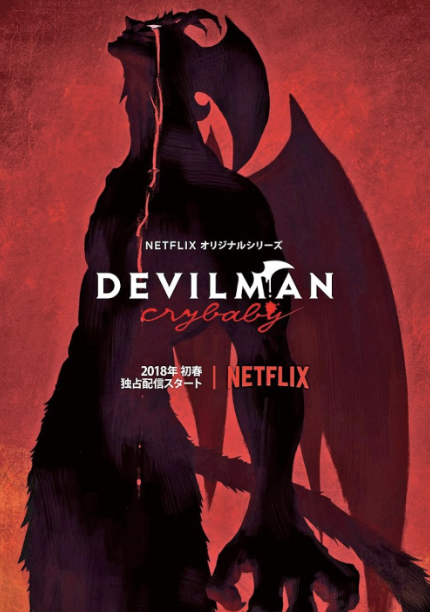
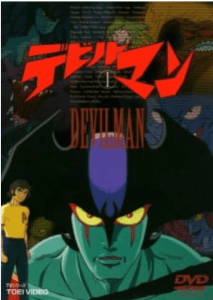
    Characters: Akira Fudo, Ryo Asuka (Satan), Miki Makimura, and Miko Kuroda

    Plot: Akira Fudo is a normal, small high schooler who is on the track team along with his friend, Miki Makimura. His childhood friend, Ryo, comes back from a research expedition from the Amazon Rainforest, discovering demons. For research purposes, Ryo takes Akira to a black sabbath party. Demons possess sinful humans, so Ryo creates a panic, which results in partygoers transforming into demons, including Akira. But instead of killing humans, Akira fights the demons. His body os Amon, a mighty demon, but his heart is human. A devil human hybrid known as Devilman. Akira and Ryo team up to fight the demons, while Akira deals with his humanity and Ryo has ulterior motives.

    Influences:

    Go Nagai; the author, writes science fiction, horror, and erotica manga. Wrote this story for the purpose of an anti-war message.

    Book of Revelations

    Berserk; Guts and Griffith reflect Akira and Ryo in design and role in the story.

    Apocalypse Now; Apocalyptic art design.

    Motifs: Running, demons, two moons, light, darkness, sex, rapping, and Devilman tv show from the 80s

    The animation uses natural lighting, dark shadows, and bright light to create a visceral, hardcore experience. This is similar to Francis Ford Coppola’s war film, Apocalypse Now. Both of them use visceral cinematography and violence to create a feeling of apocalyptic despair.

    (Apocalypse Now, 1979)

    (Devilman Crybaby, 2018)

    The animation of the running of the track team is distinct by making the runners look like wild animals, highlighting demonic nature and physiology. The fastest runners on the track team, Akira and Miko, run leaning forward and arms swinging below them, giving the appearance of wild animals. Before Akira merges with Amon, he is a scrawny and meek teenager who is the slowest of the track team. After the merger, his speed and physiology increase. The members of the track team are ambitious, selfish, and estatic while running, eventually becoming devilmen like Akira to enhance their speed and endurance. The origins of demons is revealed to be thet they are the spirits of prehistoric beasts before the mass extinction event, with the same instincts and will to survive. They just see humans as a lesser lifeform to take advantage of. In return, possessed humans have increased physical capabilities. Miki, who sees the good in other people, doesn’t become a demon, and its reflected by her normal running stance.

    (Before and after Akira’s merger with Amon)

    Some characters in Devilman Crybaby rap to express their pent up emotions. The director, Masaaki Yuasa, states that “rappers the people who speak their minds today”. When the rap gang in the show raps, its often confessions to other characters, such as their ambitions and sexual desires.

    The ending sees the moon split in half and formed into two new perfect spherical satellites. This confirms that this timeline is a time loop. Further hints at a time loop is present with the Devilman tv show from the 80s making an appearance as merch and a tv show in Akira’s home.

    Conflicts:

    The moral grey between demons and humans

    Akira’s heightened senses and libedo

    Persecution based on Darwinism

    Demons possessing humans and humans persecuting devilmen

    Ryo’s apathy and mysterious past

    “I’m not a devil, I’m Devilman.”-Akira begging to a mob

    “Don’t cry for it, it was going to die anyway.”-Ryo criticising Akira for trying to save a starving cat

    Themes: Sexuality, loss of innocence, puberty, cycle of punishment, destiny, morality in the face of fear, such as the victem reciprocates the offender, such as the humans mercilessly killing devilmen after the existence of demons is revealed.

    Ryo is revealed to be Satan who lost his memories after being exiled to Earth after rebelling against God and becoming leader of the demons. Although he doesn’t have a clear goal in mind, his apathy and coldness make his orchestrating humanity’s downfall inevitable. His punishment by God is to constantly kill the one he cares for the most, Akira. Although he is the villain, by the end, he is revealed to be the biggest victim.

    “Why am I the only one talking? Akira! Don’t leave me.”-Final line from Ryo to Akira.

    It can be interpreted that God punishes Satan by having him experience friendship, but without love, so he can destroy it himself and humanity, in an endless cycle. The presence of the 80s continuity in this timeline supports this by showing that Satan lives multiple times as Ryo, and makes the same tragic mistake.

  • This is meant to be a forum of literary discussion for post IB high school graduates. I would like to thank Mrs. Karen S. McCurdy for being my IB language and literature teacher. She prepared me for the IB test for Language and Literature, introduced me to many excellent pieces of literature, and increased my love of films and books by sparking an analytical view of them. I hope the IB class of 2025 finds this blog and has fun revisiting old IB skills. These blogs are not full on essays, just notes.